Keeping Ammunition Lot Numbers With Your Range Notes
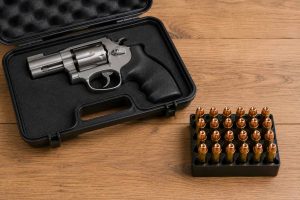
Ammunition lot numbers exist to facilitate traceability of the manufacturer's product. However, once a box of ammunition reaches the range, that number can serve to link a particular load of ammunition to a particular handgun and thereby to the range notes for that handgun resulting from that shooting session. A single word, such as "light strikes" or "unusual grouping", without corresponding lot number(s) for shot ammunition, for example, is hardly useful diagnostic information.
An essential thing to remember when creating a shooting log, is that there are more variables in a shooting session than can be reliably recalled by memory. The different cartridges may look alike but will have had different production lots, different storage histories, and will have been packaged in different ways. All of these must be identified and recorded in the log before any attempt can be made to draw any conclusions from the data.
The printed code as an identity marker
It is important to realize that the lot number of ammunition alone does not describe all the characteristics of handgun ammunition. It is not a substitute for brand, product model, caliber and type of bullet. The lot number is merely a production grouping identifier that the manufacturer uses for his internal control and for traceability.
This code must be recorded with the corresponding information for identification purposes. This means, in addition to the lot number, the range notes must also contain information such as the manufacturer, product model number, caliber, etc. Written alone, the lot number can easily be misread especially if similar coded ammunition is in the shooter's stock. This code is usually printed on the carton, and sometimes also on the inner packaging such as labels on the cardboard carriers holding the individual cartridge tubes.
Packaging also makes a big difference in how codes are recorded. A carton, label, or small inner package can be separated from the ammunition before notes are written. It is best to record the lot number at the beginning of a session to avoid relying on memory after the many Ammunition lots that are handled.
Why timing changes the quality of the record
Range notes need to be written in the same sequence that the events occurred. Thus, identification of ammunition is to be followed by a description of the session, and then the notes or observations from the range. The reversal of this is a familiar but weak form of note taking – writing down conclusions and trying to reconstruct the evidence later.
The first line can include the lot number and the box or package from which it came. The second line can contain the details for the gun and its configuration. For the remainder of the notes in that entry, the date, general information on what took place, type of shooting, any stoppages, any unusual characteristics (e.g. light strikes, unusual grouping), etc. can be entered.
What to Record: As previously noted, it is NOT required to record each sensation felt. However, record enough information to determine if what you experienced to be unusual was in fact an isolated occurrence or if it was in fact a repeatable event. As few as two or three lines of information per shooting session are required to establish such information.
Separating ammunition evidence from firearm evidence
One never knows for sure what caused a technical failure (e.g. failure to fire), e.g. could be cartridge, primer, gun ignition system or some combination of above, plus perhaps how the event was recorded. Thus one must be extremely careful not to reach hasty conclusion and assign blame prematurely.
Tracking lot numbers helps keep ammunition-related information organized, as the shooting log can subsequently establish whether the same ammunition lot was used in subsequent shooting sessions, or whether the noted phenomenon occurred with a different load of ammunition, or even if the phenomenon was related to the firearm, or not.
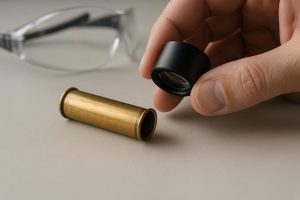
For the brass you recover during your sessions, it is good to track it as well and note it in your range notes. This will help you remember the primer's appearance, any case damage, how it extracted, etc. Just remember that recovered brass does not necessarily mean you know all the variables for that shot.
Building a record that survives mixed sessions
Mixed ammunition is worst of all. Recording fires in a session where several types of ammunition are used can lead to totally wrong results. Although all shots were fired with the same firearm, at the same range, under the same conditions, empty cases of all shots of different types of ammunition can get mixed up together and then later on be compared, perhaps to be mistakenly concluded that a certain pattern of marks appeared with greater or lesser frequency with a certain type of ammunition.
For records of mixed shooting sessions it might be useful to have a list of all ammunition tested during that session, the same way as you would have a list of all shots made with a given gun. So each block of ammunition could be treated as a block of notes within the overall shooting log. It can help to assign a short code for each block of notes within a session for the different lots of ammunition in that session. The code could be used for all subsequent notes within that block for that ammunition, and all corresponding brass.
When recording that only part of a box has been used, this needs to be clearly stated in the notes for the session. When you return to the ammunition in a later session it needs to be clear whether you are using the same lot, whether you have changed to a different pack, or whether you are simply unknown as to the source of the ammunition.
Reading patterns without overstating them
But value to the shooter is only revealed after a number of shots have been recorded. So then a pattern of shots maybe of value. The ammunition lot numbers record that two observations of gunshot damage etc. were fired from a production grouping of shots. The range notes of the shoot record that the same shots were fired from the same firearm(s), in the same circumstances, using the same technique etc.
This means that you record uncertainty, and so instead of saying "always does this" you record "observed once", "repeated during this session", "I forgot to write down lot number". If you are concerned that a particular firearm or a cartridge may be unsafe then stop immediately and seek to have it inspected by a qualified person. Find out the current official safety advice for the activity that you are involved in and check out the relevant legislation and requirements for that country and activity.
Record keeping for the collector helps in establish the historical facts as to what happened with an item, a cartridge, and how it performed. Writing down the events of what happened with a gun, cartridge(s), and the associated cases, assists in retrieving memories of past events long after they have faded away.